Posted by Samer Helbaoui
Why Global Investing Fails Without the Right Structure
Global investing is no longer optional. But building it well is far more complex than it appears.
As investor demand for international market access continues to rise, many platforms are moving quickly to add global investing capabilities. Yet time and again, global investing initiatives struggle—not because of lack of interest, but because of what sits beneath the surface.
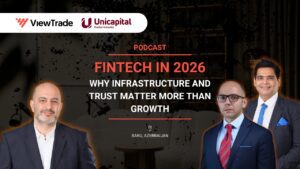
In a recent ViewTrade conversation, Samer Helbaoui, VP – Gulf Growth at ViewTrade, spoke with Tofig S. Hasanov, Director at Unicapital Investment Company, about what it really takes to build global investing with the right structure. Their discussion revealed a recurring theme: global investing succeeds or fails based on execution, infrastructure, and operating discipline—not speed to market.
Global investing is not a feature
One of the most common misconceptions about global investing is that it can be delivered as a simple product enhancement—a “button” added to an existing platform.
In reality, global investing is a business system.
Behind every international trade sits a complex network of settlement processes, reconciliation workflows, custodians, corporate actions, FX handling, reporting obligations, and regulatory considerations. Treating global investing as a feature rather than a system often leads to operational gaps that surface only after launch.
This is why many platforms encounter difficulties not at the point of launch, but weeks or months later—when scale, volume, and investor expectations increase.
Investors don’t experience access — they experience execution
From an investor’s perspective, global investing is not about “market access.” It’s about outcomes.
Investors experience:
- Execution quality
- Price accuracy
- Settlement reliability
- Timely dividend and corporate action processing
- Clear and accurate reporting
When any of these elements break down—even in small ways—trust erodes quickly. Errors in reconciliation, incorrect dividend postings, or inconsistent reports may seem minor operationally, but to investors they signal unreliability. And once trust is lost, it is rarely regained.
This is especially true in global investing, where investors benchmark their experience against established international providers.
Structure is invisible — until it fails
The “right structure” is often described as abstract, but its impact is very tangible.
Structure refers to the invisible architecture that ensures a seamless investor experience—from onboarding to execution to post-trade reporting. When structure is well designed, investors don’t notice it. When it’s weak, friction appears everywhere.
Common failure points include:
- Reconciliation mismatches
- Incorrect corporate actions
- Delayed or inaccurate reporting
- Unclear fund movements
- Inconsistent execution outcomes
These issues are rarely front-end problems. They are almost always structural.
You can’t bolt on structure later
One of the clearest lessons from the discussion was this: structure must be defined upfront.
Key decisions—such as settlement models, ledger design, reconciliation frameworks, and operating controls—are extremely difficult to reverse once volume increases. Even platforms with relatively low early volumes can face long-term consequences if foundational choices are made incorrectly.
Controls such as AML, risk limits, approvals, and eligibility rules must be embedded into the system from the start. Attempting to add them later introduces operational risk, regulatory exposure, and customer dissatisfaction.
Different investors require different structures
Not all investors interact with global markets in the same way—and global investing infrastructure must reflect that.
Retail investors typically prioritise:
- Fast onboarding
- Smaller ticket sizes
- Simple, intuitive reporting
- Educational guardrails
Institutional and high-net-worth investors, by contrast, require:
- Deep audit trails
- Complex reporting
- Multiple custodians
- Broader instrument coverage
- Institutional-grade controls
Trying to force a single structure across all investor types inevitably leads to friction—and often results in losing one segment or the other.
Infrastructure becomes the bottleneck as scale increases
Demand for global investing often grows faster than infrastructure can support.
Each new market introduces additional complexity:
- New custodians
- Different settlement cycles
- FX handling
- Local regulatory nuances
- Market-specific corporate actions
Without a robust, well-planned infrastructure, adding markets can destabilise what already exists. Fragile systems struggle to absorb complexity, turning expansion into a source of customer complaints rather than growth.
Why partnerships matter in global investing
Very few firms build global investing entirely on their own. Partnerships play a critical role—but not all partnerships are equal.
A transactional vendor relationship is rarely sufficient. Successful global investing requires partners who:
- Share responsibility for outcomes
- Provide operational guidance, not just APIs
- Help navigate reconciliation, settlement, and corporate actions
- Act as long-term collaborators rather than short-term providers
Choosing the right partner early can define the long-term sustainability of a global investing platform.
What good execution looks like to investors
From the investor’s point of view, good execution is simple:
- Predictable outcomes
- No unexpected fees
- Minimal slippage
- Settlement that works as expected
Delivering this consistently requires far more than good UX. It requires operational discipline, infrastructure resilience, and constant attention to detail across the entire trade lifecycle.
The non-negotiables for global investing
When asked what firms must prioritise from day one, the answer was clear:
- Define the operating model early
- Design reconciliation and settlement carefully
- Choose custodians and partners deliberately
- Embed controls from the start
- Treat global investing as a system, not a feature
Firms that approach global investing with this mindset are far better positioned to scale sustainably.

Comments
Latest Posts



Related Posts