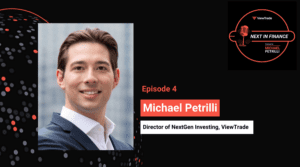
Podcast: Next in Finance (Ep 6: Michael Petrilli x Andrea Marani)
How clearing, settlement, and tokenization are quietly reshaping the way investors access global markets.
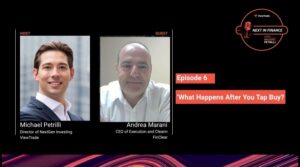
For most investors, the moment they tap “buy” feels instant. Behind that tap sits a dense layer of clearing, settlement, custody, and cross-border plumbing that most people never see — and that infrastructure is changing faster than the apps built on top of it. In this episode of Next in Finance, host Michael Petrilli sits down with Andrea Marani, CEO of Execution and Clearing at FinClear, one of the firms at the center of modernizing Australia’s market infrastructure.
Andrea brings decades of global experience across trading, brokerage, advisory, and financial technology. The conversation moves from the realities of clearing and settlement to the “build versus buy” decisions facing fintech founders, the rise of cash-on-platform and multicurrency models, the role of AI in post-trade operations, and why Andrea believes the traditional constructs of exchanges, currencies, and borders are slowly breaking down into what he calls a “global village.”
Episode at a glance
- Host: Michael Petrilli, ViewTrade
- Guest: Andrea Marani, CEO of Execution and Clearing, FinClear
- Episode: Next in Finance, Episode 6
- Topics: Market infrastructure, clearing and settlement, API broking, build vs buy, cross-border trading, multicurrency cash, tokenization, AI in post-trade
What is FinClear?
FinClear is an Australian execution and clearing firm — in U.S. terms, closest to a broking and clearing firm with a technology-led, “digital clearing” focus. It operates as a market participant and clearing participant, primarily across the ASX and Cboe markets, and clears both for itself and for third-party participants. Beyond its core clearing business, FinClear describes itself as a fintech, building out adjacent products such as its FCX private-markets capability and a multicurrency cash and FX hub.
Key topics covered in this episode
The shift from custody to direct ownership models. Andrea explains Australia’s HIN (Holder Identification Number) framework, where shares are registered directly in the end investor’s name through the ASX CHESS system, and how wealth platforms that historically ran custodial models are now extending into the HIN-based broking space through APIs.
Build versus buy for fintech founders. One of the most practical segments of the conversation. Andrea’s view: identify the core capability that differentiates your offering and build that, then license or buy the ancillary services around it. Trying to build everything — trading, banking, tax, reporting, and keeping pace with constant regulatory change — is, in his words, where firms can destroy value over time.
Cash on platform and multicurrency FX. Andrea discusses FinClear’s cash and FX hub, built on a virtual-account network, designed to give clients a multicurrency cash wallet across multiple currencies so they can fund in real time and trade global markets without crossing the FX spread repeatedly.
Reducing friction in cross-border trading. The discussion covers why seamless onboarding and account opening — including the additional documentation required for international trading — is becoming a non-negotiable expectation, and how partnering with local brokers can unlock market-specific advantages.
AI in post-trade and operations. Rather than focusing only on AI-driven advice, Andrea highlights data as the central theme: real-time dashboards, management by exception, reducing settlement fails, and using AI to move from account-centric to client-centric data views.
Tokenization and the “global village.” Andrea shares why he believes tokenization of real-world assets — digitizing real shares rather than wrapping them synthetically — represents a meaningful next phase, and how the traditional constructs of exchanges, currencies, and national borders may gradually break down.
Notable themes and takeaways
The following points summarize ideas discussed by the guest and host during the episode. They reflect the speakers’ views and are provided for informational purposes only.
- The hardest part of investing is not the front-end app; it is the infrastructure that activates the moment a trade is placed.
- Seamless onboarding is a make-or-break first impression, especially for digital-native generations.
- Access to specific securities can matter more to investors than access to entire exchanges, which carry significant market-data costs.
- Settlement cycles are compressing globally, with markets moving toward T+1 and, in some cases, same-day settlement.
- Longevity in innovation comes from applying the right technology to a real problem — not adopting technology for its own sake.
- Open-mindedness, a willingness to learn, and listening to front-line colleagues are leadership traits that matter most in a fast-changing industry.
Frequently asked questions
- Who is Andrea Marani?
Andrea Marani runs Execution and Clearing at FinClear as its CEO. He’s spent decades in and around global markets — trading, brokerage, advisory, clearing, and the technology underneath all of it. - What is FinClear?
FinClear is an Australian execution and clearing firm that thinks like a fintech. It’s a market and clearing participant across the ASX and Cboe Australia markets, clears trades for third parties as well as itself, and has built out adjacent capabilities in private markets, multicurrency cash, and FX. - What actually happens during clearing and settlement?
These are the steps that kick in after you hit buy or sell. Clearing is where the trade details and each side’s obligations get confirmed; settlement is the moment the securities and cash actually change hands. It’s unglamorous work, but it’s what keeps markets trustworthy — and, as this episode argues, it’s where a lot of the hard problems live. - What is a HIN (Holder Identification Number)?
It’s a feature of the Australian market specifically. Under the ASX CHESS framework, a HIN registers shares directly in the investor’s own name on the registry, rather than holding them under a custodian. Andrea explains why wealth platforms built on custodial models are now moving into this space. - “Build versus buy” — what’s the decision really about?
Every fintech eventually faces it: build a capability in-house, or bring in a partner for it. Andrea’s take is refreshingly blunt — build the thing that genuinely sets you apart, and license or partner for almost everything else, because trying to build it all is how firms quietly burn through resources. - Why does “cash on platform” matter?
Because moving money shouldn’t be the slow part of investing. When cash sits ready on the platform across multiple currencies, investors can move between markets and opportunities without repeatedly crossing the FX spread. Andrea walks through how FinClear approached this with its multicurrency cash and FX hub. - What does tokenization mean here?
In this conversation, it’s not about synthetic wrappers. Andrea is talking about digitizing a real underlying asset — issuing a token that represents an actual share — and why doing it that way could make access, settlement, and distribution far more efficient over time. - How does AI fit into post-trade?
Less in the headline-grabbing “AI picks your stocks” sense, more in the engine room. Andrea points to data as the real story: dashboards that surface problems in real time, managing by exception, cutting settlement fails, and shifting from account-centric to client-centric views of who’s actually behind an account. - What’s this episode about, in one line?
How the invisible layers of investing — clearing, settlement, custody, APIs, cash infrastructure, AI, and tokenization — are reshaping the way people and institutions reach global markets.
About Next in Finance
Next in Finance is ViewTrade’s podcast series exploring the technology, infrastructure, and ideas shaping the future of investing. Hosted by Michael Petrilli, each episode features leaders building the next generation of financial services across global markets.
Explore more episodes of Next in Finance →
Disclaimer: The views and opinions expressed in this podcast are those of the speakers. They do not necessarily reflect the official policy or position of ‘ViewTrade Holding Corporation’. This podcast is intended for informational purposes only and does not constitute financial, legal, or investment advice. Listeners should consult their own advisors before making any financial decisions. ‘ViewTrade’ make no guarantees as to the accuracy or completeness of any information presented. Regulatory requirements and market access capabilities may vary by jurisdiction and are subject to change.

Comments
Latest Posts


Related Posts