Posted by Samer Helbaoui
Extended Trading, GCC Capital Flows & the Future of Global Investing
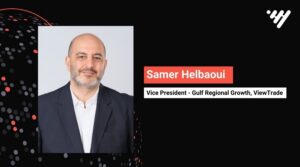
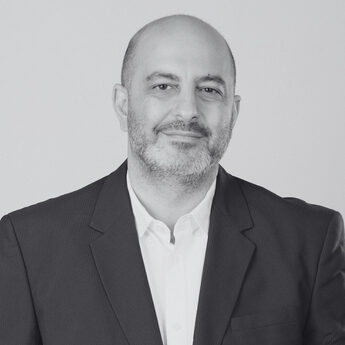
Insights from Samer Helbaoui, Vice President – Gulf Regional Growth at ViewTrade
From 24/7 trading infrastructure to cross-border access and Gen Z investor behaviour – what’s changing, and why architecture matters.
Samer Helbaoui, Vice President of Gulf Regional Growth at ViewTrade, shares his perspective on how extended trading hours, global market access, and generational change are reshaping investing. From the emergence of GCC financial hubs to AI-enabled platforms and fractional ownership, he believes the industry is going through a lasting structural shift — not just another market cycle.
Host: Lubna Hamdan
Speaker: Samer Helbaoui, Vice President of Gulf Regional Growth, ViewTrade
Key takeaways
- Extended trading is a full-stack shift: What appears to be a front-end feature requires 24/5 or 24/7 infrastructure, real-time risk systems, global liquidity aggregation, and continuous monitoring.
- Cross-border infrastructure is critical for GCC investors: Seamless access to U.S. and global equities depends on direct exchange connectivity, clearing, custody, FX, and regulatory alignment.
- The GCC is becoming a capital hub—not just a destination: With sovereign wealth expansion and regulatory modernization, the region increasingly acts as both a source and conduit of global capital flows.
- Scalability must be architectural: API-driven infrastructure, elastic cloud environments, and automated compliance workflows are essential as participation grows.
- Investing processes will be revolutionized by AI: From personalization to the possibility of AI agents acting on behalf of investors, automation is becoming a part of the trading process.
What does “extended trading hours or overnight trading” really mean?
Extended trading hours or overnight trading may be a very simple concept: trading outside of regular trading hours. But being able to offer this kind of trading experience is a big deal.
The following are what is needed to be able to offer extended trading hours:
- Strong routing + matching + market data infrastructure (that do not “sleep”)
- Low latency infrastructure that is designed for extended trading hours
- Margin, credit, and risk management engines that are running in different time zones
- Clearing and settlement coordination that is in sync with markets such as NASDAQ and NYSE
- Liquidity aggregation that minimizes fragmentation and thin after-hours markets
- Cybersecurity monitoring + operational support that is genuinely 24/7
It is not just a matter of “extending hours.” It is making sure that performance, controls, and trading quality are maintained during extended trading hours outside of the regular trading day.
Cross-border market access for GCC investors
The dream of many GCC investors is simple: easy access to U.S. stocks and global markets. But what it takes in the background is a strong cross-border infrastructure, especially in terms of connectivity, clearing, custody, and regulatory compatibility.
Samer highlights that having direct connectivity to the major trading venues can help improve trading quality, but without end-to-end support (routing, clearing, custody), global access can become more fragmented, expensive, and operationally complex, especially when speed and consistency are required.
Why the UAE and Saudi Arabia matter in global capital flows
One of the major shifts that Samer sees as taking place is the way in which capital moves. The GCC is not just passively receiving capital. It is now actively investing capital out into U.S., Asian, and European equity markets and private markets.
With the rise of sovereign wealth funds, more developed capital markets, and ongoing regulatory changes, areas such as the UAE and Saudi Arabia are also positioning themselves as the hubs for structuring and distribution, thus enabling a more multipolar world capital system.
What’s next: scalability, fractional trading, and AI in investing
Looking ahead, Samer thinks that capabilities such as multi-market access and fractional trading will become the new standard. But he is firm that the successful participants will not be those with the most appealing front-end but those who have scalable architecture.
This means:
- API-infrastructure that allows new markets and new products to be readily integrated
- Cloud or hybrid architecture that is elastic and scalable to satisfy the sudden needs of IPOs, earnings announcements, and macroeconomic events
- Automation of onboarding, compliance, and reporting to enable the business to scale with growth
The investor side is also seeing a change in investor behaviour, especially among Gen Z investors, who are more likely to invest in products and brands they can relate to, and increasingly, as a community. AI is also being integrated more into the workflow, from delivering personalized insights to the possibility of AI agents that can act on the preferences of investors (whatever those preferences may be in the future).
Disclaimer
This content is for informational purposes only and does not constitute investment, legal, tax, or financial advice. Any views expressed are those of the speaker as of the interview date and may change. Availability of products, services, and market access depends on applicable laws, regulations, and client/system capabilities.
Comments
Latest Posts
Related Posts